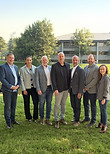
Construction Storyteller: Pinkard’s Longtime Proposal Writer Retires
July 25, 2025
In his job, and in life, Ned Foster describes himself as an oddball.
Unlike most people he works with at Pinkard Construction, he doesn’t have an engineering degree or a background in business or accounting, but rather journalism. His colorful wardrobe of Hawaiian shirts stick out in a sea of muted polos and dress shirts, as does memorable Shreveport, Louisiana accent, which belies the fact that he’s lived in the high elevation forests above Denver for over 30 years.
As Pinkard’s on-staff proposal writer since 2002, Ned has been the voice of Pinkard Construction for over two decades. In his 28-year career as a proposal writer, 23 of those years spent at Pinkard, he has written at least 1,000 Request for Proposal (RFP) responses, helping supply the lifeblood of projects that keep a general contractor alive.
He’s also responsible for submitting the majority of Pinkard’s 22 National Excellence in Construction awards, organized by Associated Builders and Contractors (ABC), which are judged by an exhaustive, highly competitive proposal process. As a testament to his writing prowess, of the 16 projects that Ned submitted on, 14 of them won first place “Eagle” awards, one earned a second place “Pyramid,” and only one went home emptyhanded. He also served as an Eagle judge and National Business Development Committee member for ABC National for 13 years.

What’s even more amazing is that Ned arrived at Pinkard with little-to-no construction industry knowledge. What has made Ned such an effective asset to Pinkard, and as anyone who lost track of time talking to him in his office can confirm, is his remarkable gift as a storyteller. As skilled at listening as he is at writing and talking, Ned is a rare breed, a sharp-witted, deeply introspective renaissance man with the principles and insatiable curiosity of a true journalist.
While much glory in the construction world rightfully goes to the people who do the actual building, Ned has served an invaluable role at Team Pinkard. To use one of his favorite analogy forms (sports): as the superintendents, project managers, and estimators battle it out in the field, Ned has been there in the press box, dutifully documenting the plays, interviewing the players, and recording our company’s history. His subsequent stories of teamwork, innovation, quality, schedule, budget, and overcoming challenges have been crucial tools for demonstrating our construction expertise to prospective clients.
In the words of retired CEO Jim Pinkard: “Ned cares more than most people. He’s competitive, he wants to win, and he puts everything into what he’s doing. Whether talking to an architect, a client, or our guys in the field, he knows how to talk to people, absorb their expertise, and then put that into a clear cohesive message. Even though he didn’t arrive with construction expertise, he worked hard to become hyper-literate in this world, and he left an indelible mark on the company as a result.”
This week, having just celebrated his 70th birthday, Ned Foster is finally entering the world of retirement, where he looks forward to spending more time with his wife and “kids” (his two border collies), while focusing on his numerous passions: playing guitar, cooking, reading, watching films and TV, drinking a good martini, and chasing the occasional bear off his mountain driveway.
As Pinkard bids farewell to its beloved storyteller of 23 years, we asked Ned a few parting questions about his life at Pinkard.

How are you feeling about retirement?
Excited. I’m ready and freaked out at the same time. I’ve never been the guy who lived to work, but Pinkard was the perfect job for me. I don’t think I would have made it anywhere else.
Why’s that?
Because I'm an oddball, a Jack Kerouac type who was probably meant for more artistic and creative pursuits. But fortunately I landed at Pinkard in the right time in my life, at the right time for the company, where I had some of the best people around me who could look past my weaknesses and shortcomings, see my potential, and let me grow into it. There were days I was completely overwhelmed, but it was the perfect job for me. It taught me my strengths, revealed my insecurities and shortcomings, and gave me a career.
So how did you end up at Pinkard Construction?
It's kind of a crazy story. I was always trying to work in a field that allowed me to indulge my passions. After college I had done about four years in New Orleans, basically working in HR for Avondale Shipyards, the largest industrial employer in Louisiana. I burned out at that, and that's when I got into the restaurant business as a fine-dining waiter, which I loved passionately. I wanted to be a chef and sommelier, which is how I moved out to Colorado in 1988, to work at the Flagstaff House in Boulder. Then my back went out, and in the years after I did everything from starting a portrait photography business to working as an electrician’s apprentice and teaching skiing at Winter Park, before starting to wait tables again.
Then one day one of my restaurant customers told me she’s a technical writing recruiter, and I said, "You know, I got a degree in journalism I've never used.” She asked for my resume, and two years later she called and said, “I've got an entry level job for you,” so I went to work for Lockwood Greene Technologies, the oldest engineering firm in the United States at the time. I worked for them for a while, and they ended up closing the office due to some incredible mismanagement, so I went to Centric-Jones Construction, and they went out of business as well. One day I get a call from a friend I used to work with at Lockwood Green, saying, “I know somebody that needs you. Call this guy named Jim Mellor [Pinkard’s recently retired head of marketing and business development].” That’s a whole ‘nother story.
What was the Marketing Department like in the early 2000s?
Before me the whole department was set up around Mellor as the brains of the operation. He had this whole network of boilerplate writeups – basically the answers to every question that we’d ever been asked – that were all numbered, and so whenever a proposal needed to be done, he would tell his secretary, let's use intro number three for this, writeup number two there, and she'd put it all together like that. That had worked really well up to that point, but when I was hired to take over proposal writing, that way of doing things doesn’t really fit my personality, and I thought there was a better way.
What was different about your approach?
A really good example is the Eagle awards. We decided we were going to submit Thomas Connole [Pinkard’s 2002 project for Denver Housing Authority], this incredible gut and remodel of a 10-story, concrete affordable housing high-rise with asbestos. DHA wanted to make the bedrooms bigger, but they didn't have any room to do so, so we demolished the entire side of the building and made it wider. It was crazy.
So when it came time to submit for the award, I didn’t consult with anyone who had done it before. I just looked at the requirements and started digging in, doing what made the most sense to me. Knowing that the only way to tell a good story is to know as much as possible about the topic, I interviewed everyone I thought could offer me some insight. Why was the job hard? What did you do to make it easier? What were the problems and how did you solve them? And most importantly, what is the proof that you did a great job?
I was lucky that Denver Housing Authority’s program manager Ron St. Clair was a storyteller. It was from Ron that I learned that story tillering was the key to a winning proposal or award submittal. That set the stage for the rest of my career.
From that I basically wrote the Eagle submittal completely on my own, which Jim Pinkard then proofed and gave me great insight into what was not clear. After submitting it, we won first place.

What makes a good proposal writer?
I've never really thought about it to the point of articulating, but I think it’s the same thing that makes a good journalist, which is having the curiosity and the drive to tell a good story. I was always talking to superintendents and project managers to learn what made projects special. Without that knowledge of why something is special, you can't sell it.
How has proposal writing, and construction marketing in general, changed over your tenure?
Before me, it was very much an assembly line, boilerplate approach, which was very efficient and managed to win us a lot of work back then. As the industry has evolved and Pinkard has continued to chase more and more ambitious projects, the proposals have become more complex, and we have become more and more sophisticated as a result. For the longest time it was just me writing and submitting the proposals on my own with minimal team input, and our RFPQ responses were largely just text-based. Today it’s a massive team effort, and the documents are much more complicated with graphics, pictures and design.
What were your favorite proposals to work on?
The ones where I got to go really deep with the project team. On one of the last jobs we won, I ended up talking to [Pinkard superintendent] Matt Gabriel for two hours to help craft the project approach for this challenging renovation. I kept asking him questions about how we would overcome all these challenges, and after talking at length about how hard this job is going to be, he said, “Man, I'm sorry. All I'm doing is complaining.” I said, “Dude, your complaints are exactly what I need to hear!” That gave us so much brilliant insight, and I think it won us the job. That’s the thing I loved most about my job: having these fascinating conversations with brilliant people who build incredible things.
If you could do any other job in construction, regardless of the qualifications, what would it be?
Superintendent. I’m just amazed by their common sense, and their ability to look at things, collaborate and tactfully solve problems. That applies to project managers, preconstruction, and project engineers too. It requires an amazing hybrid set of skills to overcome complicated physical challenges while dealing with people and keeping things in budget to turn out a beautiful building. To me they are some of the smartest people in the world.
So what kept you at Pinkard all this time? What are you going to miss most?
The people. Of course the work was a good fit for me, but it’s the people and the relationships that made the work good. I'm proud of the fact that we, as a company, hired good, moral, brilliant people, and I've created so many memories with them over the years. They’re what makes it so hard to leave.